Vertical software has fallen 43% this year. DevTools, just 21%. The gap between them, twenty-two percentage points, tells you what markets actually believe about AI.
As Michael Mauboussin argues in Expectations Investing, prices contain information about what markets believe will happen.
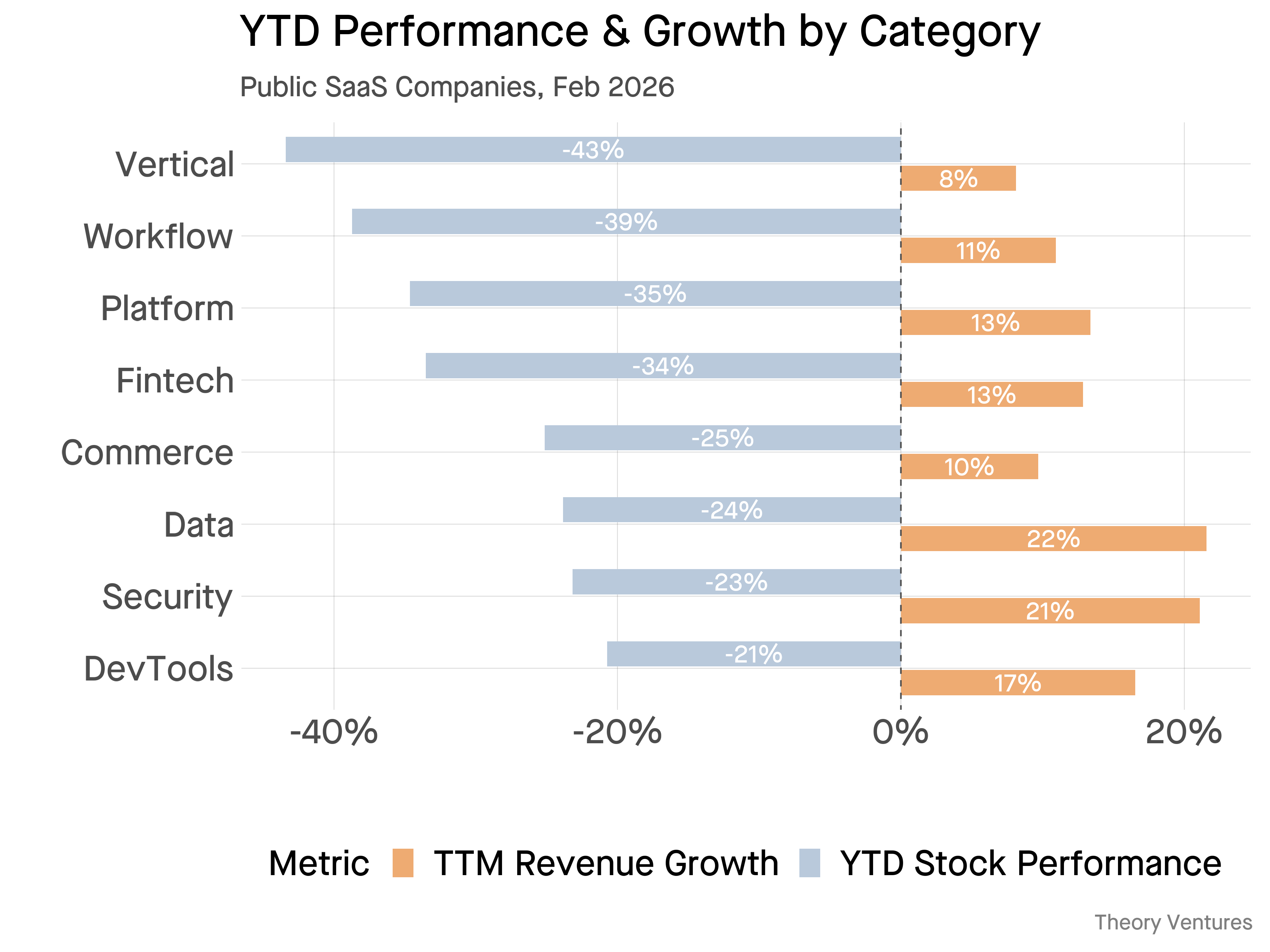
The conventional interpretation is that investors fear AI will replace certain categories of software. But that explanation misses something important.
Vertical software companies like Veeva, AppFolio, & Procore possess genuine moats : regulatory barriers, deep integrations that make their products operating systems for entire industries, years of accumulated domain data that is particularly relevant for AI. If anything, these companies should be harder to displace than generic workflow tools.
Yet vertical software trades at the steepest discount. Because they simply aren’t growing that fast.
Workflow companies, Monday, Asana, Smartsheet, whose core value proposition sits squarely in the crosshairs of AI agents, have fallen only slightly less at 39%.
Two clusters emerge : slow growers like vertical software (8%) and workflow (11%), and fast growers like data infrastructure (22%) and security (21%). The gap in YTD performance between these clusters is roughly 20 percentage points. The correlation between forward growth and forward revenue multiple remains strong at 0.51.
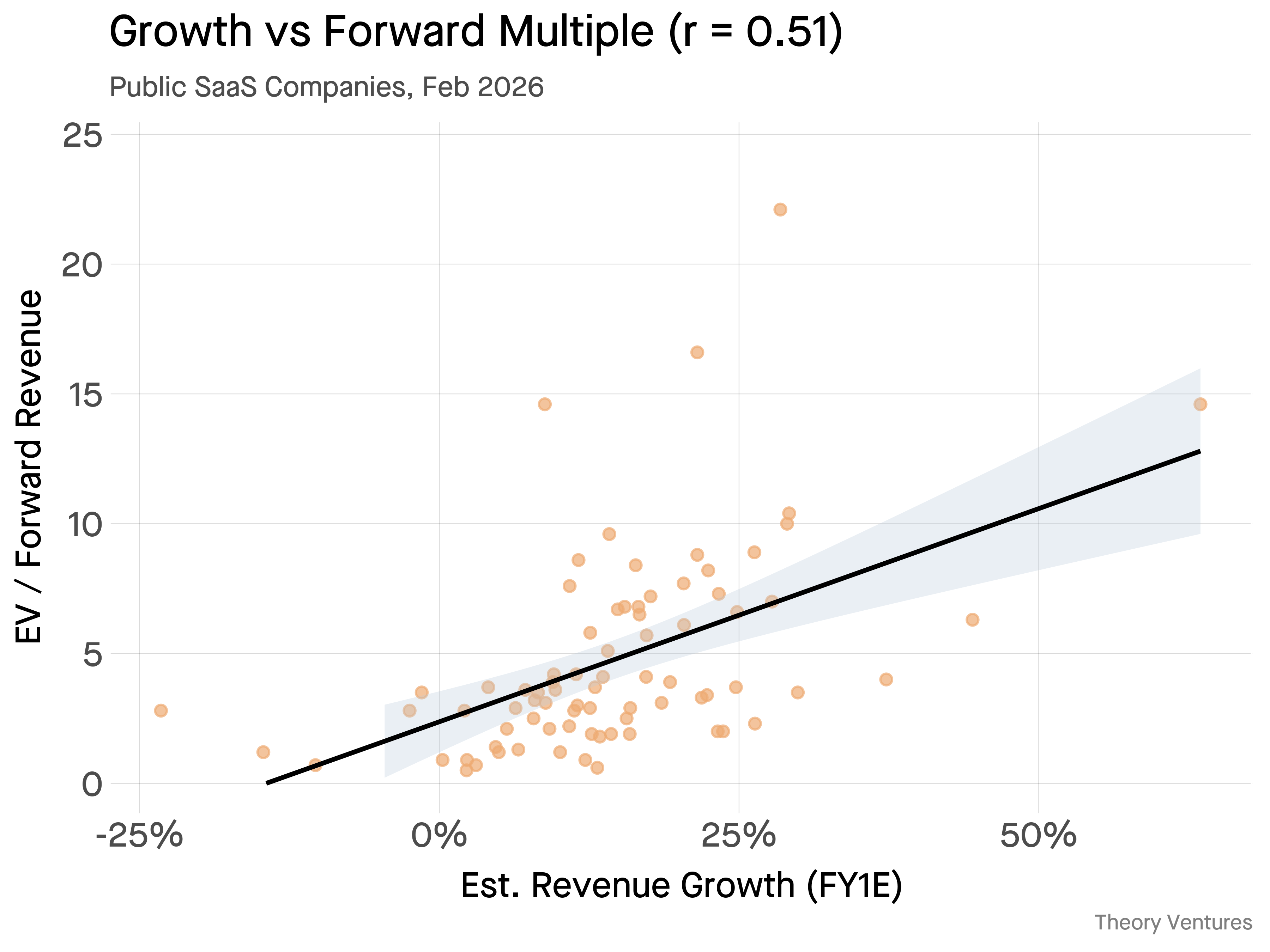
AI changes the economics. More code generated means more code to manage, review, & deploy. Atlassian’s recent earnings confirm the thesis : Atlassian Intelligence surpassed 5 million monthly active users, cloud revenue grew 26% to cross $1 billion for the first time, & RPO grew 44% year-over-year.
The data infrastructure tailwind is structural. More AI means more queries, more embeddings, more vector operations.
Security remains the perennial insurance policy enterprises must pay. AI adoption brings additional surface areas to protect.
Investors are asking public software companies a simple question : can a company grow when the next wave of automation makes its customers more efficient rather than more numerous?
The stocks falling fastest are the ones where investors doubt the answer.