It’s an important question and one that arises most often as a SaaS startup scales. Churn, masked by growth, becomes a limiting factor of growth. How much should the business invest in managing churn?
Our SaaS benchmarks from earlier this week tell us the average public SaaS company has a 3% monthly revenue churn or a 2 year lifetime and a sales efficiency of 0.8, which implies a 5 quarter pay back period on cost-of-sales and cost-to-serve.
Using those numbers, the contribution revenue chart for a typical customer looks like this. The revenue of the first 15 months pays for the acquisition costs and the remaining 9 months before the customer churns are contribution margin.
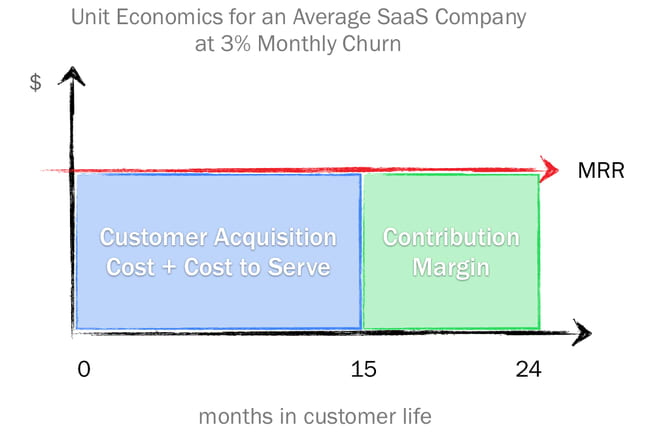Presuming the business signs customers to 12 month contracts, a customer who renews pays a year’s worth more of contribution margin minus the customer success team’s salaries.
To be worth the investment, customer success must drive at least drive one more month’s worth of margin in addition to the 9 created by the standard, 2 year-and-out customer.
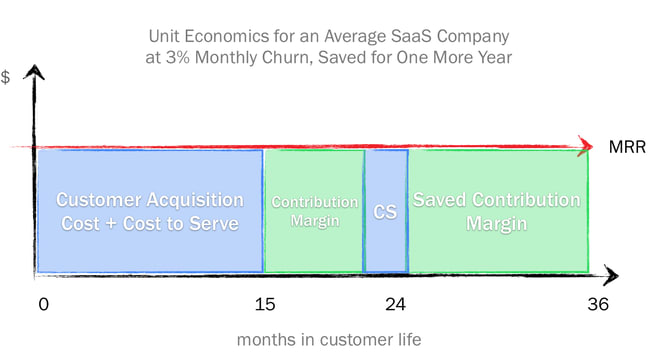
Assume a customer success team can save 30% of customers who are at risk. In the success case then, the contribution revenue chart looks like this:
For the remaining 2/3 of cases, the chart looks like this:
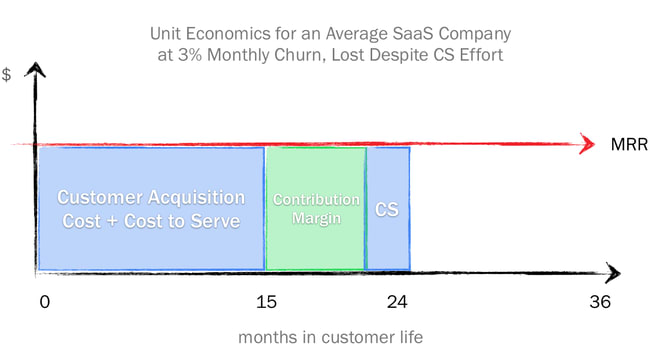But on average, the customer success team saves about 4 months of contribution margin per customer which means company can spend up to 3 months' worth of contribution per customer on churn management.
For a company at a $3M annual recurring revenue clip with customer ARRs of $1k, there are 3000 customers. On each, the company could spend about $156 (which is the $83 in revenue per customer, multiplied by an average gross margin of 63% in SaaS companies' early years) to save or a customer success budget of $39k per month.
Of course, each company’s metrics will vary and will impact the maximum spend on customer success but the framework should hold across most subscription businesses.