Blockchains are databases application developers use to build novel user experiences. Just as hundreds of different databases exist in web2, different blockchains have evolved in web3.
In September, I published the State of Web3 in Data. I’ve been watching one of those charts very closely : slide 25 which tracked L2s & L1s.
Layer 2s (or L2s) like Arbitrum & Optimism, sit atop Ethereum (an L1). They provide faster & less expensive transactions for application developers.
The average Ethereum transaction costs about $2.60 as of this writing, whereas on Arbitrum it costs $0.07, a 97% savings.
For an individual transaction, the difference may not matter, but for application developers & frequent traders, those dollars accumulate over time. In the long-term, lower prices will drive more activity, essential for broader adoption of web3 technologies.
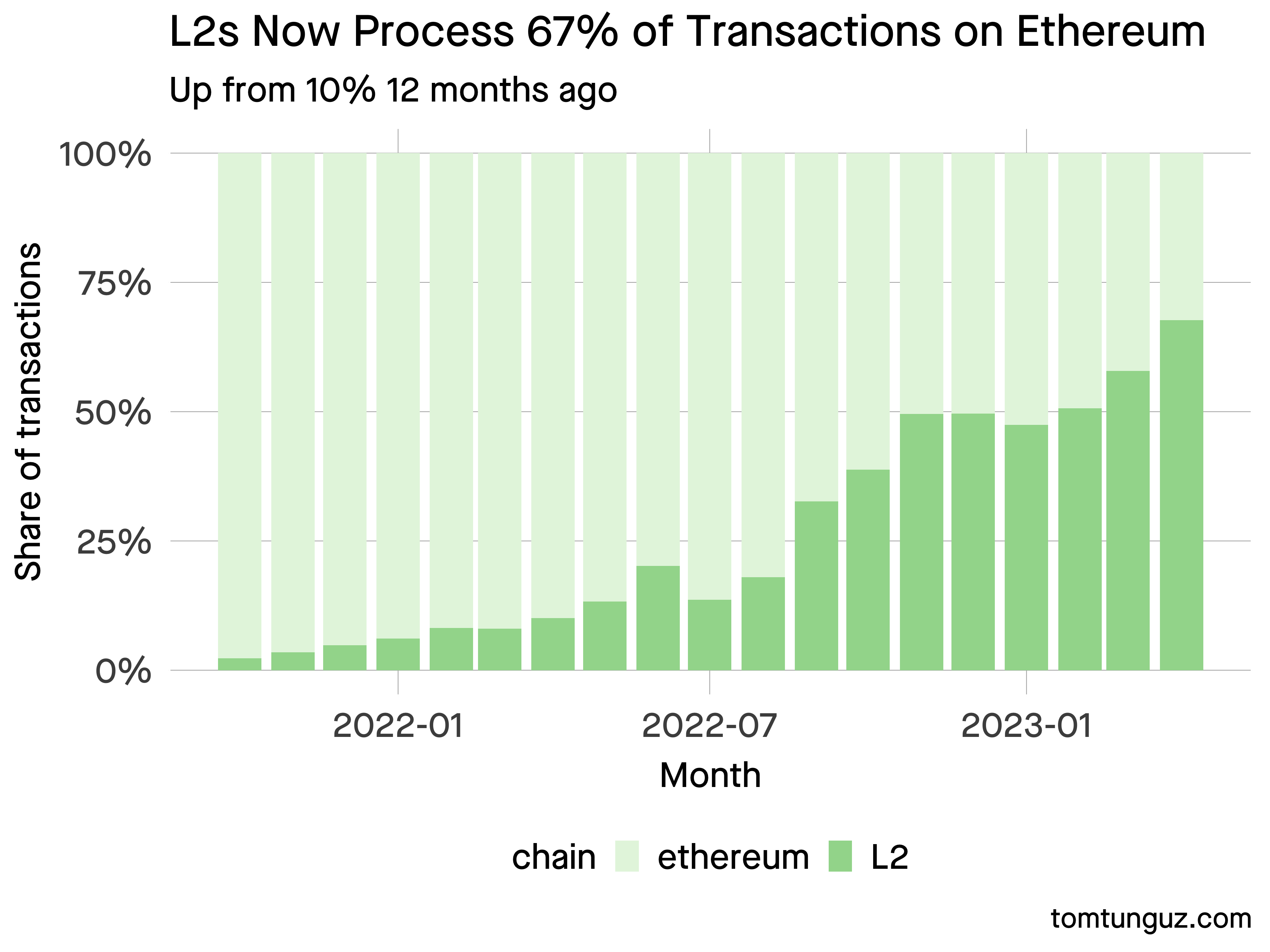
In September, L2s processed about 30% of Ethereum transactions. Six months later, that figure is 67% according to Dune. Within the Ethereum ecosystem, this number should asymptote to 90-95%.
Economics works - even in the sometimes strange world of web3.
As web3 evolves, we will see more instances of economics driving behavior :
- the evolution of token drops to more efficient marketing strategies because airdrops are uneconomical compared to classic venture rounds.
- developers choosing particular blockchains for applications based on workload including more expensive, more secure databases called zero-knowledge (zk) in web3 or less expensive faster databases like L2s
- revenue as a core driver of valuation in web3 startups & publics