Marketing is one of those words without meaning. Or at least a consistent meaning for most people. Recently, I met a very bright marketer who broke down a few of the different marketing disciplines and matched them to a freemium sales funnel. His framework is a stroke of genius. I’ve drawn it below.
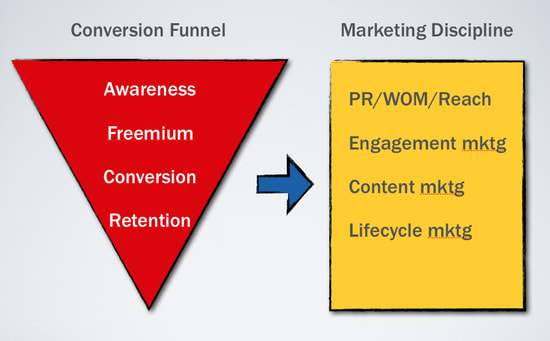The triangle on the left is a standard freemium customer conversion process. First customers become aware of the product, then they use the free version of the product, then they convert to paid either by themselves or with the aid of an inside sales team, and finally they are retained as customers.
The rectangle on the right contains the marketing disciplines used to grow and optimize customer acquisition metrics on the right. The list isn’t meant to be comprehensive but does get the gist across.
At the top of the funnel PR, word of mouth and reach marketing are the tools to drive more awareness. Examples include press mentions, viral product features, app store promotion and features, web page optimization, and so on.
Second, engagement marketing draws freemium users into the products. Engagement marketing includes product tutorials and videos, welcome emails and support.
Third, content marketing closes accounts. Content marketing includes blogging to targeted segments within the user base about useful product tips and social interest posts like customer testimonials. Additionally, content marketing inside sales collateral, like the scripts used over the phone by the sales and support reps. Data science also fits in this stage when customer segmentation, remarketing, direct marketing and online acquisition can be most effective.
Last, lifecycle marketing retains customers by reinforcing the value proposition of the product customers pay for. Customer success teams may call customers with low usage to educate them about the product. Managed support communities build trust into the customer base. And of course email drip campaigns can be quite effective.
You’ll notice that the tools used in each of the stages isn’t unique. Email, blogging, customer interaction might be used in all or just one of the steps. It depends on the product and sales cycle.
But the goals of the customer interaction change during each step. It’s the responsibility of the marketing team to first understand the objective at each stage in the sales process and best equip their teams with the tools in product, eng, and sales with the various marketing disciplines to maximize success.
This framework really helped me understand the many different disciplines of marketing and when to apply them. I hope it’s helpful for you and your business.