Enterprises learned a lesson from cloud data warehouses. They handed over both data & compute, then watched as the most strategic asset in their business, how they operate, became someone else’s leverage, which created an opportunity for Iceberg.
Fool me once…
Leaders have recognized their companies need a new system of record for AI agents in the form of a context database. There are two different kinds of these context databases :
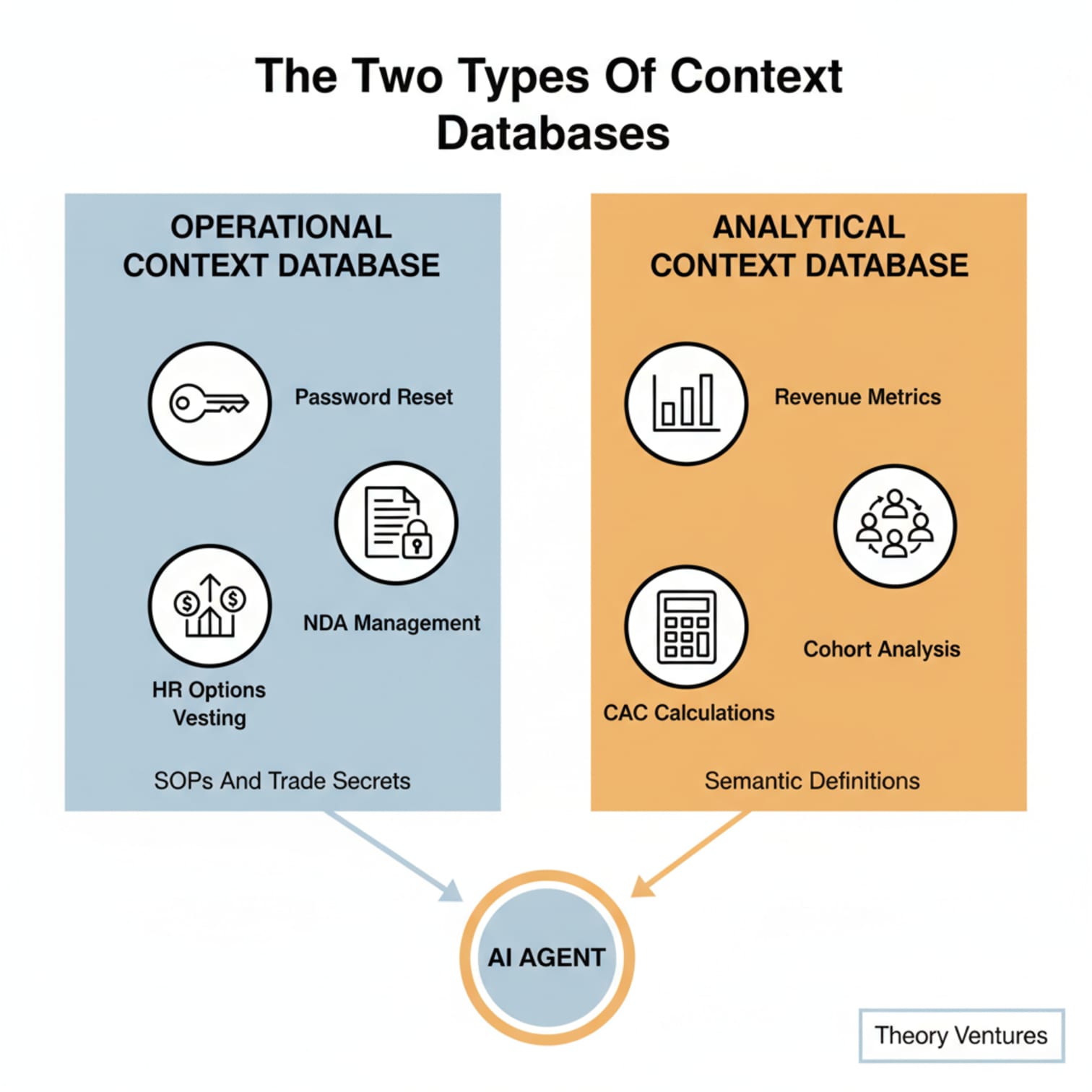
Operational context databases store standard operating procedures & institutional knowledge : when a customer calls about resetting a password, when legal reviews an NDA with a new prospect, when HR answers questions about options vesting for a new hire.
All of these processes represent trade secrets & intellectual property, which are key assets for a business. Capturing them from employees ensures continuity in processes & builds a sustainable, defensible asset.
Analytical context databases are a semantic evolution of semantic layers : they contain definitions & calculations for metrics like revenue or customer acquisition cost.
Semantic layers told AI what data meant. Analytical context databases teach AI how to reason about it.
Steven Talbot’s recent piece on Omni’s agentic analytics architecture describes :
a coordinator mechanism, which decides which tool to use next based on the question, the results, & what’s already been tried.
The key to both operational & analytical context databases isn’t the databases themselves. It’s the feedback loops within them.
Steven’s system adapts mid-flight, retries when things break, or stops when it has something useful to show. This creates an ever-improving cycle of accuracy. Accuracy creates trust. Trust creates adoption. Adoption creates more feedback. Companies that develop the best feedback loops will build the most valuable context databases.

Context databases enable the future of process automation, representing the real promise of AI within the workforce. It’s the evolution of RPA (robotic process automation), but it’s RPA & process discovery injected with non-determinism.
This non-determinism is essential for the success of AI agents. It allows for exception handling, forestalling one of the failure modes of the first generation of RPA. AI agents are excellent at ingesting large volumes of content & reasoning about them.
The move from manual context engineering to automated context platforms is inevitable. Context databases will be sold as standalone products & bundled. Enterprises will come out of this transformation for the better : with evolving systems that improve over time.