Plastic User Interfaces

Salesforce has gone headless : a sales person can update their deal sheet without ever logging into salesforce.com through AI. Many companies are following suit with MCPs. English as an interface to complex systems is a tremendous innovation.

And yet, some of the most sophisticated thinkers in AI are pushing more than markdown text, a format AI & computer systems use. These thinkers espouse richer UIs :

“Imagine using iMessage to do everything, when in fact every other app has a unique interface…With e-commerce, you want a very rich user interface.” - Brian Chesky, CEO of AirBNB

Read more

SpaceX's Limitless Ambition : An AI Conglomerate

After 24 years as a private company, SpaceX filed its S-1 yesterday. The filing reveals an AI-era conglomerate. SpaceX has three distinct segments : Space, Starlink, and AI.

In 2025, SpaceX generated $18.7 billion in consolidated revenue with $6.6 billion in Adjusted EBITDA. But the real story lies beneath those top-line numbers.

SpaceX revenue by segment time series

SpaceX runs three businesses with fundamentally different economics :

Read more

The Unsustainable Subsidy

Google’s AI triples in price each year.

Google Gemini: Flash and Pro Pricing

OpenAI’s flagship model was seemingly subsidized for a while, before rising again.

OpenAI API Prices: Flagship Falling, Then Rising Again

Anthropic’s AI has been the same price for a little bit & decreased for the most powerful models.

Read more

Observations on Writing with AI

As I was paging through Good Writing, Anne Lamott’s new book, I wondered what AI would say about twisting cliches & finding hidden metaphors (chapters 18 & 19).

Over the last 16 years of writing, I’ve read books about writing, hired an editor, & used AI. I’ve fine-tuned models to mimic my voice, tested more than 10 AI systems, & written many post with AI, with some Hindenburgs I’ve kept public as proof despite my embarrassment.

Read more

The First Derivative of Inference

The fastest-growing companies in AI & software are either selling AI directly or reselling inference. At worst, they are the first derivative of inference.

Inference is the largest & fastest growing market in technology today, surpassing the database market & projected to be three times the size within seven years at $250 billion.1, 2 By selling inference or indexing a business to it, they grow at spectacular rates.

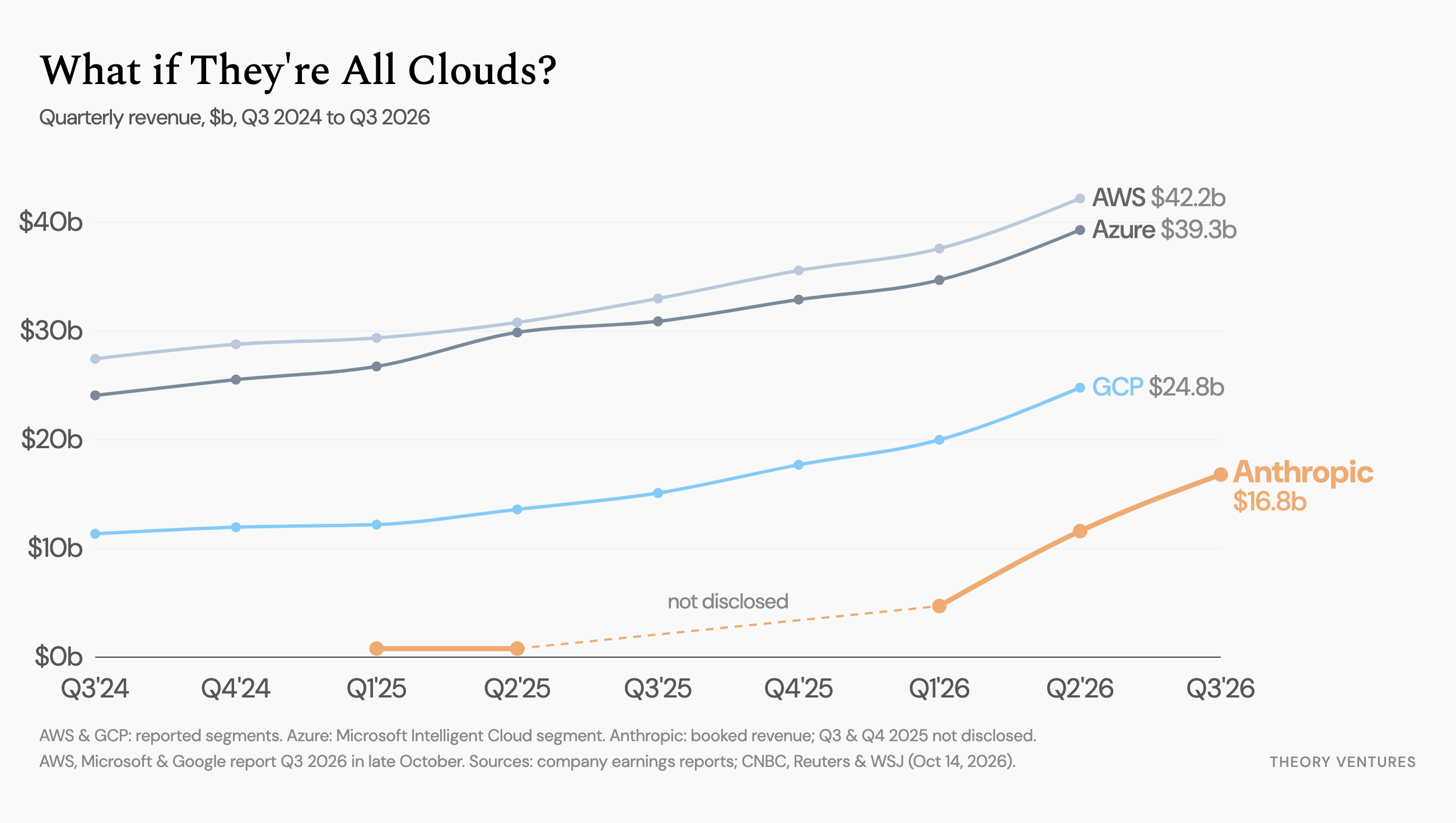
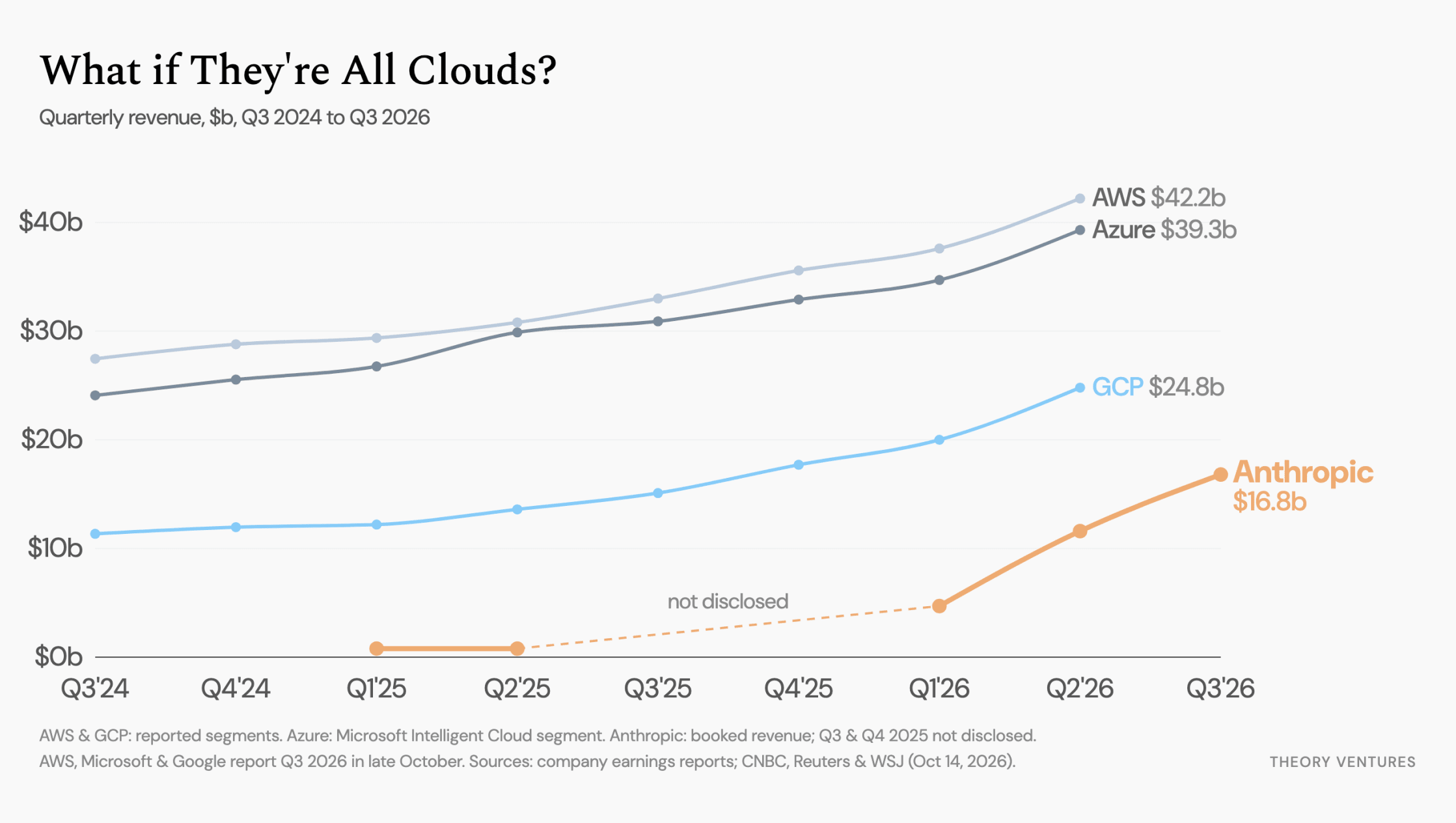
Anthropic has booked $9b & $10b in consecutive months.3 Google Cloud is growing 63% at an $80 billion run rate.4 Most businesses selling inference are exploding.

Read more

What Would AI Email Cost?

In yesterday’s post (which an agent pushed in raw outline form via email!), I wrote about the future of AI email. What does that future cost?

chart_monthly_cost_by_model

If you are using state-of-the-art model ranging, it costs between $22 to $130 per month. Would you pay for that? At work, I imagine, many would. Let’s take the middle case of $26/month raw cost.

Read more

The 6 Messages That Actually Matter

Nobody will open Gmail five times a day in five years.

The average knowledge worker receives 121 emails per day.1 That’s one every four minutes during working hours.

The inbox is a conveyor belt that keeps accelerating. You open Gmail. You read. You decide. You respond. One at a time. But the belt doesn’t wait. It just moves faster.

AI Email Architecture diagram showing how 121+ daily emails flow through AI processing into verbatim and processed streams, feeding a personal context layer

Today’s triage is generic : “This is from your boss. I need to work on that today. Next. Spam. Archive. Spam. Archive. Newsletter, read & archive.” Tomorrow’s is personal. User-defined skills & rules. Programming in English that encodes your priorities, your relationships, your workflow.

Read more

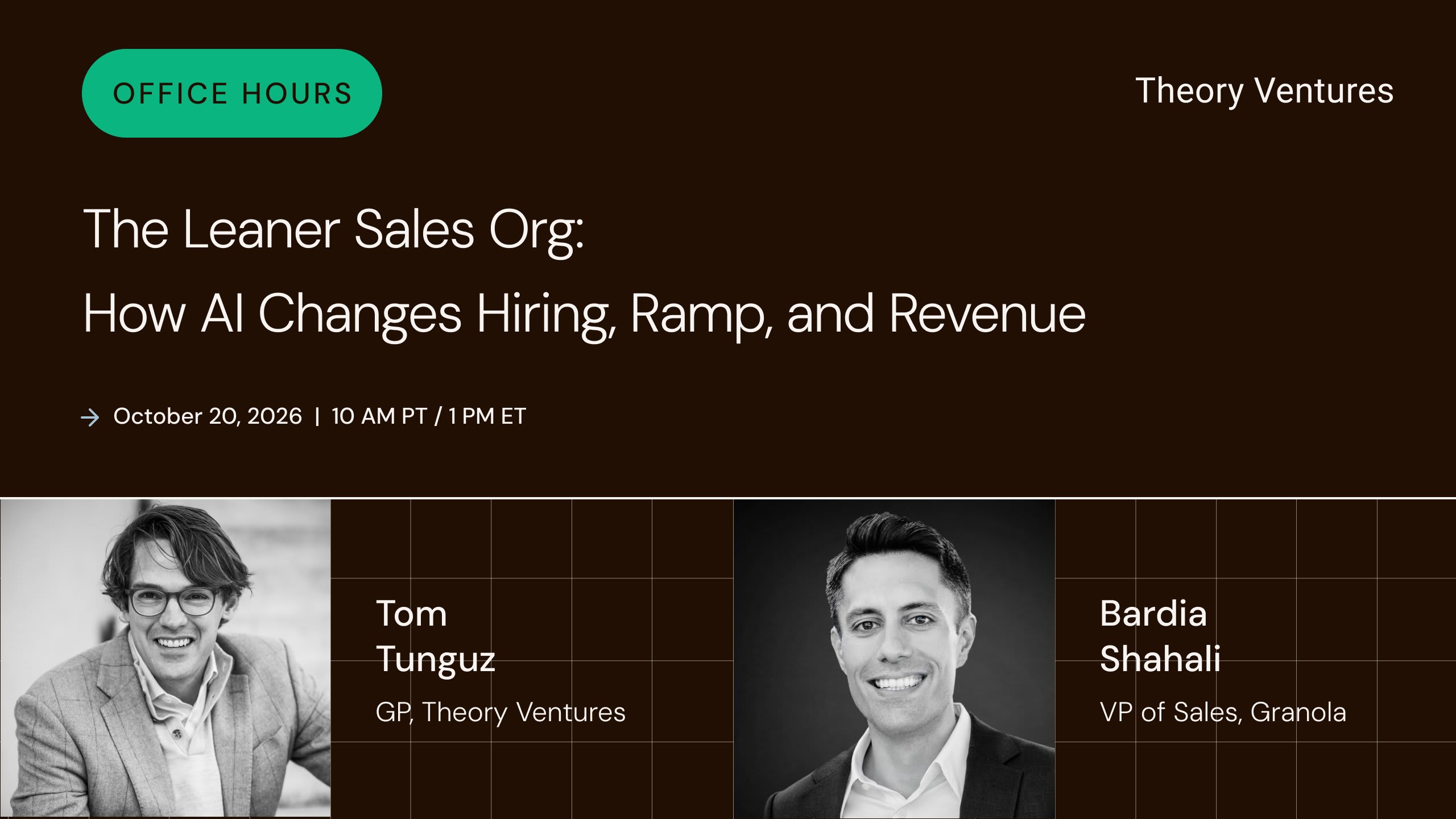
2026 Theory GTM Survey

It’s time for the 2026 Annual Theory Go-to-Market Survey. This is a brief 25-question survey.

Our goal is to understand how startups have evolved their sales, marketing, customer success, and cash management over the last several years by comparing these results to our surveys from 2022 through 2025.

We will publish these results and answer questions about them at upcoming Office Hours.

This year, we’re focused on five key hypotheses. Each is designed to be rigorously testable with the survey data:

Read more

Localmaxxing

As demand for AI inference explodes, I’ll be asking a lot more of my little computer.

How much more?

Over the past five weeks, I’ve been using local models to see how much of my daily work I can accomplish without the trillion parameter models in the cloud. The answer is half.

Category Count % of Total Example
Other 521 35.3% Catch-all for unstructured requests
Scheduling 254 17.2% Check availability, propose meeting times
Market Research 192 13.0% Competitor analysis, fundraising data
Summarization 184 12.4% Transcript review, video summaries
Email & Inbound 170 11.5% Draft replies, follow-ups, forwards
Engineering 147 9.9% Debug scripts, API fixes, CLI tasks
Admin 10 0.7% Travel, expenses, reimbursements

If you classify these 1.4k tasks by category, half can succeed on a local 35B model. Email & Inbound, Scheduling, Summarization, & Admin total 618 tasks (41.8%). Market Research & Engineering split roughly 50/50 between simple tasks (data lookups, script fixes) and complex ones (multi-source synthesis, architectural decisions). That gets us to 50%.

Read more

Securing the Agentic Enterprise

Jonathan Jaffe, CISO at Lemonade

Enterprises run on AI agents. So do the attackers.

What does it mean to build, secure, and operate AI systems when both sides - defenders and attackers - are automated?

Jonathan Jaffe, CISO at Lemonade, is one of the most forward-thinking security leaders in this age of AI, with more than 25 years of experience in technical security roles since 1997.

Read more