We build teams in pyramids today. One leader, several managers, many individual contributors.
In the AI world, what team configuration makes the most sense? Here are some alternatives :

First, the short pyramid. Managers become agent managers. The work performed by individual contributors of yore becomes the workloads of agents. Everyone moves up a level of abstraction in work.
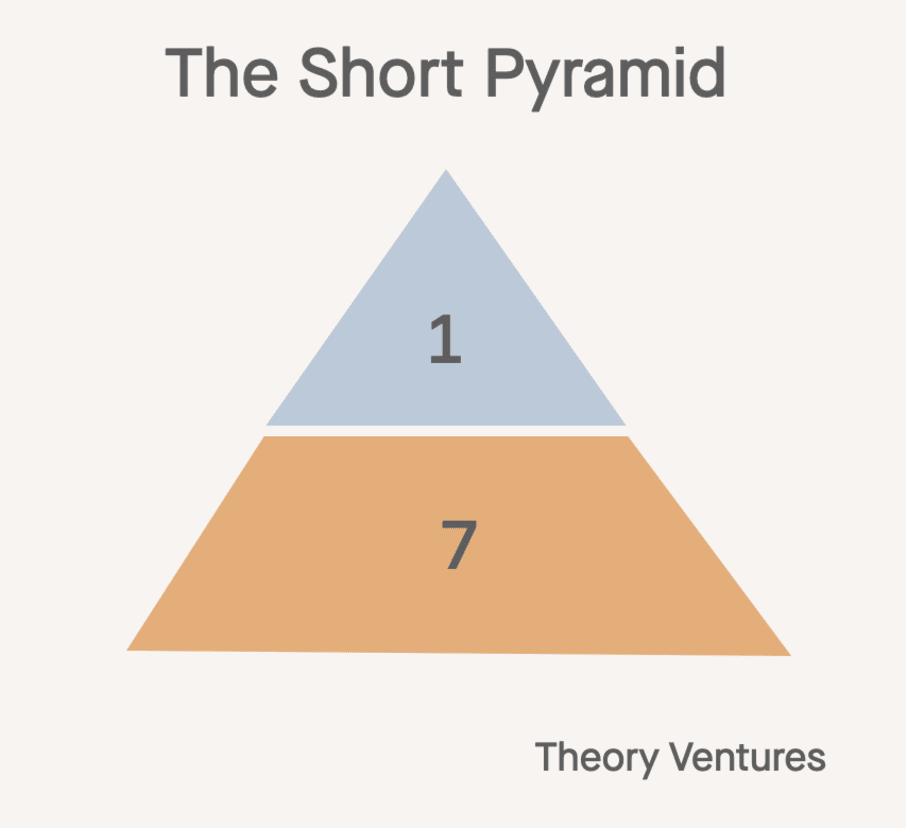
This configuration reduces headcount by 85% (1:7:49 -> 1:7). The manager to individual contributor ratio goes from 1:7 to 1:1. The manager to agent ratio remains 1:7.
Second, the rocket ship 🚀!
One director, seven managers, 21 employees. Everyone in the organization is managing agents, but these agents reflect their seniority. The director manages an AI chief-of-staff, the managers are player-coaches, both executing goals themselves & training/coaching others on how to manipulate AI successfully, which cuts the span of control by half.

This configuration reduces headcount (1:7:49 -> 1:7:14) by 53%.
The future is not one-size-fits-all.
Here’s the twist: not every department in a company will adopt the same organizational structure. AI’s impact varies dramatically by function, creating a world where the shape of a company becomes more nuanced than ever.
Sales teams will likely maintain traditional pyramids or rocket ships. Relationships drive revenue, & human empathy, creativity, & negotiation skills remain irreplaceable. The classic span of control models still apply when trust & rapport are paramount.
R&D teams present the greatest opportunity for the short pyramid transformation. Code generation is AI’s first true product-market fit, generating 50-80% of code for leading companies.
Customer success & support might evolve into hybrid models: AI handles routine inquiries while humans manage complex escalations & strategic accounts. The traditional middle management layer transforms into something entirely new.
This evolution challenges everything we know about scaling teams effectively. The old wisdom of 6-7 direct reports breaks down when managers oversee both human reports & AI agents.
The recruiting burden that historically justified management hierarchies transforms too. Instead of finding & developing human talent, managers increasingly focus on configuring AI capabilities & optimizing human-AI collaboration.
If the company ships its org chart, what org chart do you envision for your team?