When the neologism was popularized in 2004 by Tim O'Reilly, the words Web 2.0 captured a desire for the web to become interactive. It was a description of a movement towards social media and engaging users on the web. But more than an idea, it carried a design aesthetic which focused on the user, user experience and engagement. After all, users wouldn’t participate on a hostile site.
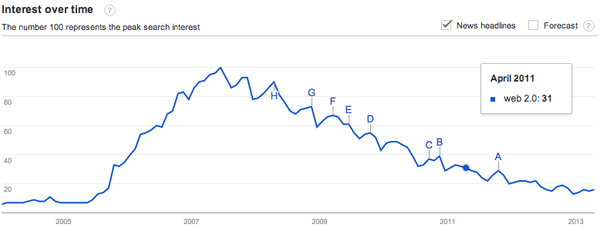
We’re no longer in the Web 2.0 age - look no further than the Google Trends data to prove the point - but the relentless pursuit of the best user experience lives on in a new era, the IRL (in real life) era.
The IRL era is all about mating technology and the real world. IRL means paying for a coffee with a mobile phone that never leaves your pocket (Square), or pressing a button on an app to order a taxi pickup (Uber), or checking into a flight using a mobile barcode (Passbook), or unlocking your home’s front door with a button (Lockitron), or scanning an in-store barcode to find an item cheaper on the web and buying it with 1-click (Amazon) or changing your commute route because of a bad accident (Google Now).
When backend software meets the real world through a mobile phone, that’s an IRL experience. The payments systems are in place, the integrations with airlines and taxis and inventory systems and physical things like locks exist.
IRL apps require radical simplicity in their design. Otherwise, they simply won’t be used. As a result, these apps are single purpose and do just one thing well.
Because they are the bridge between a physical and a digital world, IRL apps also require a mastery of many different skills: radically simple mobile design, backend and API integrations, mobile application development ability, business development for key partnerships, and mobile app distribution to reach users.
In Web 2.0, web pages and social interactions on the internet became accessible - and that was a pretty big wave. But the possibilities for engaging users IRL, where they spend the majority of their time are so much larger.