A laptop on my desk now handles 78% of my AI work, with the rest sent to the cloud. The shift came out of my skill distillation work.
Here’s how it works.
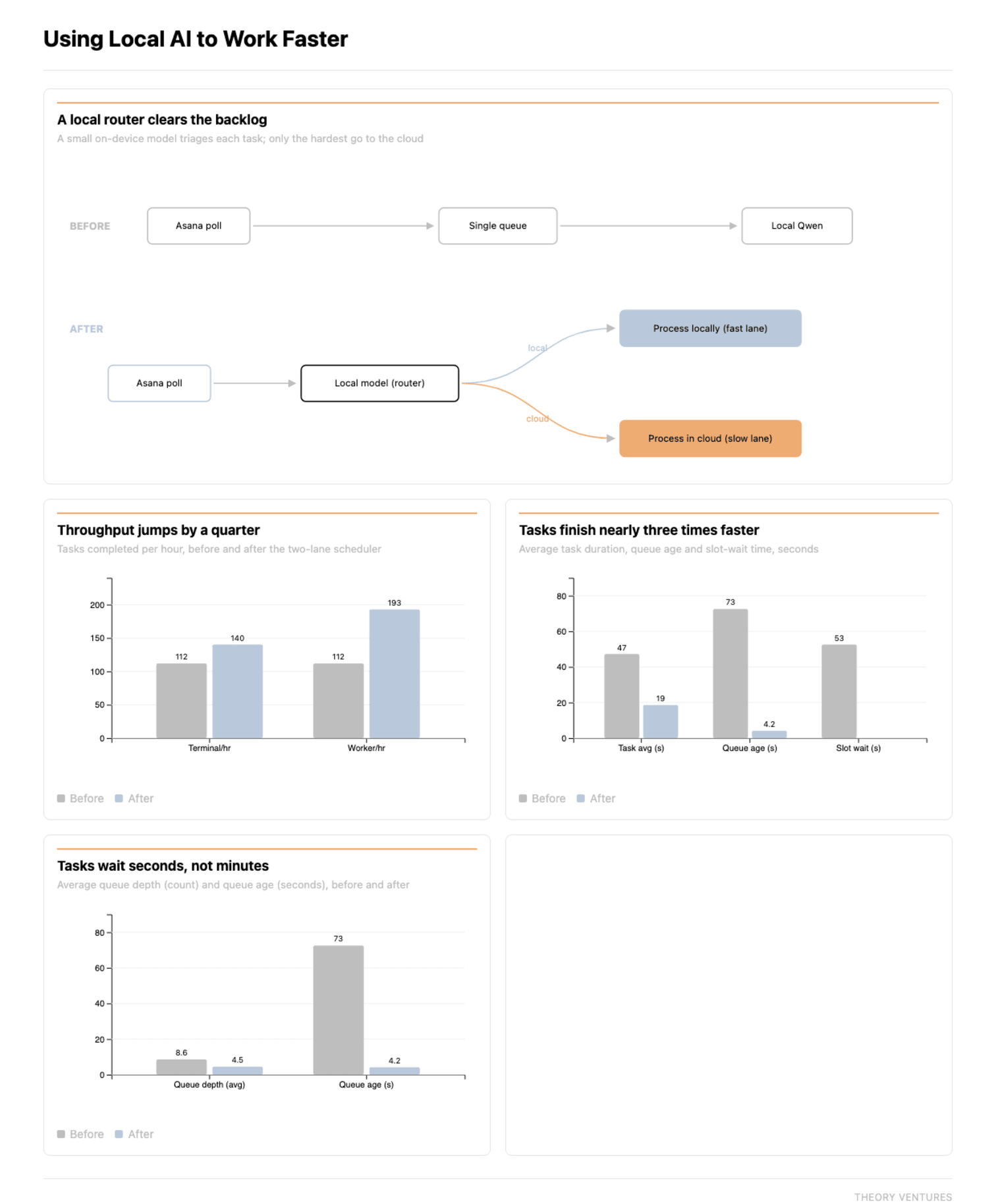
I create tasks in Asana. An agent sees the task : scheduling, email triage, research, a CRM update ; & classifies it as easy or hard. If it’s straightforward, a local model on my Mac handles it in seconds. If it’s complex, the same model routes it to a cloud model.
Across the last seven days, daily peaks reached 88%.

As the workload grew, the two-lane design paid off. Throughput jumped about 25%, average task duration fell from 47 seconds to 19, & queue age dropped from 73 seconds to four. Nothing about the work changed. Small, fast tasks simply stopped waiting behind big, slow ones.
The task factory that uses distilled skills is now humming along with 25% more throughput, queue age down 94%, & a much more responsive system. For now, the cloud handles the hard fifth. The Mac handles the rest.
It’s the minimill of agentic work. Nucor’s minimills1 started small, capital-light, & close to demand; within a generation they outflanked the integrated steel giants.
Every laptop, phone, & edge device with enough memory to host a distilled model becomes its own minimill : routing locally, paying cloud rates only for the hard fifth. Tens of millions of these will proliferate inside companies in the next few years, each one quietly absorbing much of the work that today shows up on a hyperscaler invoice.
-
Nucor began in the 1960s by melting scrap steel in electric-arc furnaces rather than smelting iron ore in giant integrated blast-furnace mills. Each minimill was a fraction of the size & cost of an integrated plant, sited near regional demand, & ran on flexible, lower-cost labor. The integrated mills dismissed minimills as fit only for low-grade products like rebar. Over the next thirty years Nucor moved up-market into sheet steel & structural beams, & by 2014 had become the largest steel producer in the United States, while most of the integrated giants (Bethlehem, LTV, National) had gone bankrupt. Clayton Christensen used the story as the canonical example of disruptive innovation in The Innovator’s Dilemma. ↩︎