In 1989 Boris Yeltsin stopped at a Randalls supermarket in Houston, stunned by the variety of ice cream.1 OpenRouter is that supermarket aisle for AI.
And shoppers make surprising choices : OpenAI’s year-old open-source model GPT-OSS 120b2 commands 36% of Anthropic’s Opus 4.8 volume.3
Why does a model from August 2025 still hold a third of the traffic of a frontier model that shipped weeks ago?
The market for tokens has segmented.
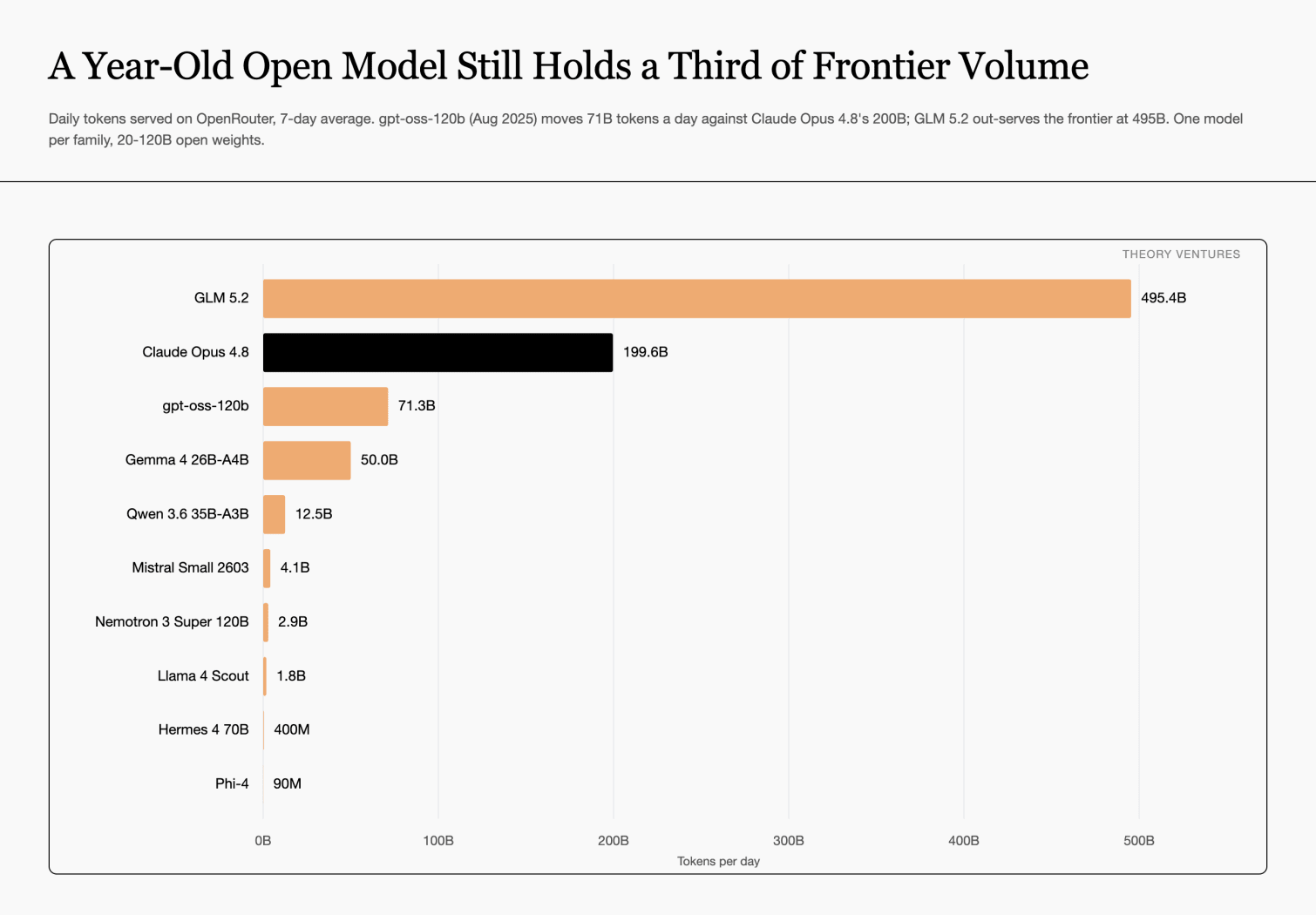
Segmentation happens because buyer needs vary.
The segmentation is accelerating driven by competition. Last week Anthropic shipped Opus 5, smaller & cheaper than Fable,4 explicitly to contest the ground that Moonshot’s Kimi 3 targets.5 In the mid-model-market, Poolside launched Laguna S 2.1, a US mid-market model.6
Size (small, medium, large, XL), origin (US v China), architecture (dense vs sparse), accuracy (coding focused or general), speed (tokens per second), modality (text-only or vision) ; there are many flavors of AI.
I spent the weekend replacing the model that runs my agent. The incumbent is Gemma 4 26b; the challenger is Laguna S 2.1, a 118-billion-parameter model. By every number I expected to matter, the 118b model should have been slower.
On my M5 Max both generate at the same speed, because Laguna is a mixture-of-experts architecture: 118 billion parameters live in memory, but only 8 billion activate per token. A 118b model now runs at the decode cost of a 26b model, which pulls frontier-class quality down into the local tier.
The accuracy shows up where it matters. My local stack runs a coding & email agent on tool calls, & across the models I have cycled through, the tool-call failure rate falls from 29.4% to 20.1% as active parameters climb.7 Laguna reduces error rates by 7 percentage points over the 26b model it replaced.
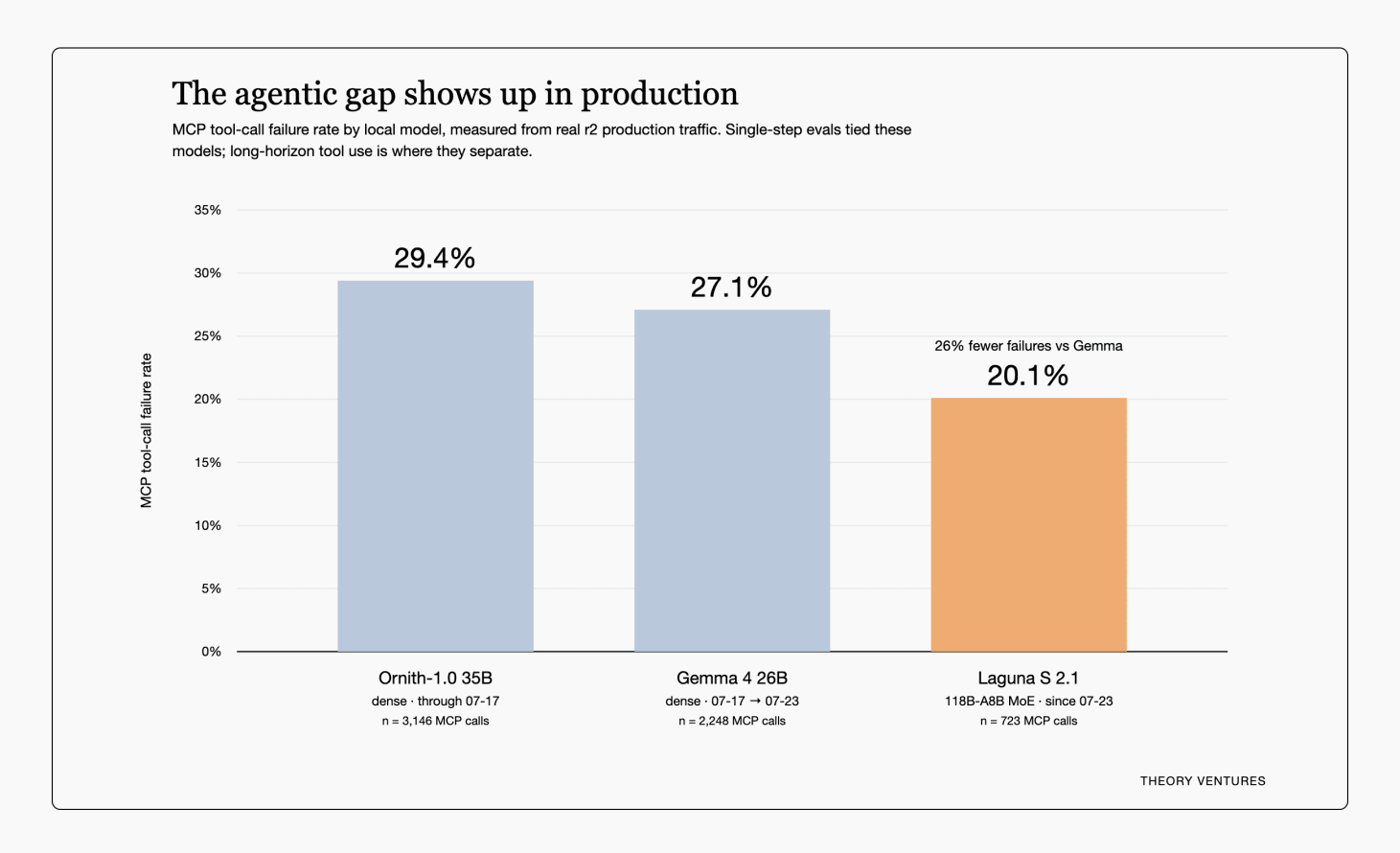
Segmentation is the sign of a healthy competitive market. The frontier still serves the world’s hardest tokens. It no longer has to serve all of them, & the tier on my laptop just got a much higher ceiling ; a trend that competition will push forward inexorably.
-
Boris Yeltsin’s 1989 visit to a Houston grocery store, a Randalls in Clear Lake, September 16, 1989. ↩︎
-
Introducing gpt-oss (OpenAI), released August 5, 2025. ↩︎
-
OpenRouter model activity pages, 7-day average, retrieved 2026-07-27: GPT-OSS-120b, GLM 5.2, Claude Opus 4.8. ↩︎
-
Anthropic debuts Claude Opus 5 at half the price, launched July 24, 2026. ↩︎
-
Moonshot’s Kimi 3 is expected to close the gap with Anthropic’s Opus 4.8 (TechCrunch). ↩︎
-
Introducing Laguna S 2.1 (Poolside), a 118B-total, 8B-active open-weight model released July 22, 2026. ↩︎
-
Author’s production data: MCP tool-call logs from a local coding & email agent, measured across three local models over five months. ↩︎